




Pubblicato il 17 August 2026 da Redazione in Actuality, Actuality in Monaco, Events, Lifestyle, Monaco
Public Drinking Fountains in Monaco: 78 Water Points Helping Residents Beat the Heat and Reduce Plastic
First installed in 1871, Monaco’s public drinking fountains are once again at the heart of daily life during the summer of 2026, offering residents and visitors free drinking water while helping reduce single-use plastic consumption
Share News:
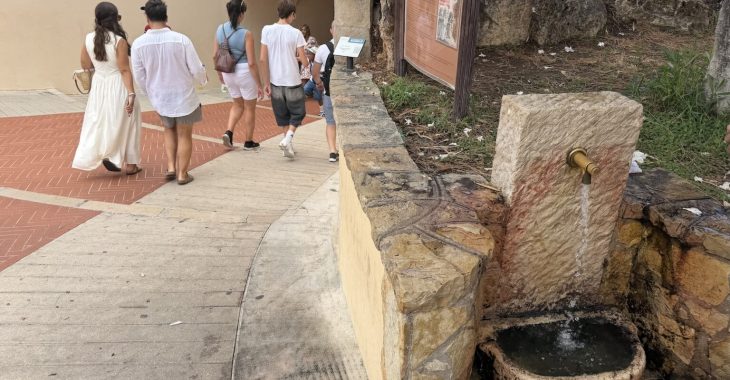
In Monaco, summer 2026 has brought renewed attention to a simple and historic feature of the Principality’s urban landscape: public drinking fountains. With 78 fountains located throughout the different districts of Monaco, residents and visitors can stop for a drink, refill their reusable bottles and find some relief during the hottest days of the year.
The fountains are not merely a useful public service during the summer. They have been part of Monaco’s history for more than a century and a half and today also represent a practical way to reduce the use of single-use plastic bottles.
Monaco’s public water supply has a history dating back to 1871
The first public drinking fountains in the Principality were installed in 1871, at a time when running water was not yet available in every home.
“At that time, few people had taps in their homes, so people would go to the fountains to collect water,” explains Marine Peglion, Deputy Director of the Société Monégasque des Eaux.
Since then, the city has changed dramatically, as have the habits of its residents. The fountains, however, have remained part of Monaco’s urban landscape. Some have been replaced or restored, while others have been added over the years, bringing the total to 78 public drinking fountains across the Principality today.
They are spread throughout different neighbourhoods and come in a variety of designs. Some are made of green metal and retain traditional brass taps, while others are built in stone, with particular attention paid to ensuring that they blend into Monaco’s architectural and landscaped surroundings.
Monaco’s drinking fountains offer a practical response to summer heat
During the hottest days of summer 2026, these small urban features have become particularly popular.
Residents and tourists stop at the fountains to drink, refill reusable bottles or simply cool down. It is a simple habit, but an increasingly important one during periods of high temperatures and limited rainfall.
Having access to free drinking water in public spaces also makes it possible to reduce the purchase of disposable plastic bottles.
In this sense, Monaco’s drinking fountains connect a tradition that began more than 140 years ago with today’s environmental priorities. The same infrastructure that once allowed residents to collect water is now helping promote more sustainable habits.
The Place du Palais fountain that also serves dogs
Among Monaco’s 78 drinking fountains, one has a particularly interesting story — and it involves animals as well.
It is located on Place du Palais, next to the Rampe Major and near the statue of Francesco Grimaldi, known as “Malizia”. Its distinctive feature is a small basin at the bottom, allowing dogs to drink as well.
The decision to preserve this particular design is linked to an anecdote involving Prince Albert II.
When workers were preparing to replace the old fountain, the Sovereign reportedly approached them and asked what they were doing. When he was told that the new model would not include the lower basin for animals, Prince Albert II asked that the previous design be retained.
It was a simple but meaningful request: animals accompanying their owners on walks through Monaco should also have access to drinking water.
Today, with summer temperatures reaching particularly high levels, that decision seems more relevant than ever.
From historic fountains to new-generation models
Monaco’s network of public drinking fountains continues to evolve.
Among the more recent installations are fountains located at the bottom of the Jardin d’Apolline, in front of the Grand Ida building, and near Sporting Monte-Carlo, in an area where the landscaped flowerbeds have recently been renovated.
The new models maintain a connection with local tradition. They are made from La Turbie stone, but are slightly taller and more contemporary in design than the historic fountains.
The aim is to integrate the new installations into Monaco’s urban landscape while preserving their essential purpose.
From 1871 to 2026: the city has changed, but the purpose remains
Over more than 140 years, technology, urban planning and residents’ habits have all changed. The reasons for stopping at a public fountain have changed too.
In 1871, the fountain was often where people went to obtain the water they needed for everyday life, as many homes did not yet have running water.
In 2026, it has become primarily a place to refresh, refill a reusable bottle before continuing a walk through the city and, at the same time, avoid purchasing another plastic bottle.
Monaco’s 78 public drinking fountains therefore tell a story of continuity. An infrastructure created to meet a fundamental need more than a century ago continues to fulfil that same essential function today, while adapting to the changing needs of the city and its residents.
In a summer marked by heat and drought, public drinking water is once again playing a central role. And in Monaco, finding a place to drink often simply means looking around.
Latest news
You might also be interested in:

3 September 2024

11 February 2026
21 February 2026
Latest Articles

16 October 2026

16 October 2026

16 October 2026

16 October 2026

16 October 2026
16 October 2026
Most Read Articles

24 January 2024
28 January 2026

28 January 2026
16 October 2026
16 October 2026