




Hervé Di Rosa in Cannes: “Mirages of the World” Brings Over 40 Years of Art and Travel to La Malmaison
Until November 8, 2026, La Malmaison on the Croisette presents 103 works by the French artist, exploring painting, sculpture, popular culture and inspirations gathered through more than four decades of travel
Share News:
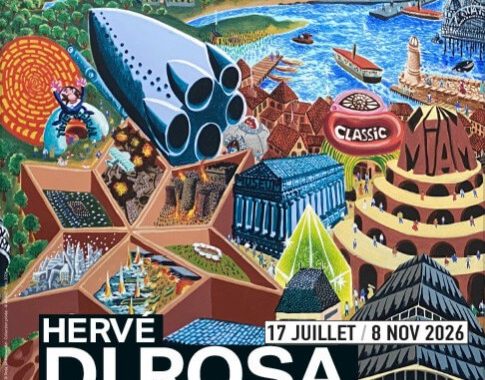
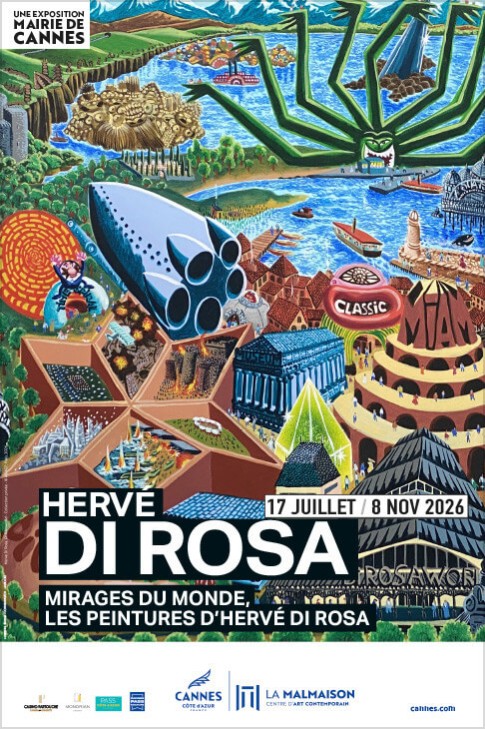
In Cannes, contemporary art takes on a new perspective, becoming a journey through images, cultures and distant worlds. Until November 8, 2026, La Malmaison, one of the Croisette’s leading exhibition venues, is hosting Mirages of the World, a major retrospective devoted to Hervé Di Rosa, one of the key figures of Figuration Libre.
The exhibition brings together 103 works, primarily paintings, spanning more than forty years of the artist’s career, from his beginnings in the 1980s to his most recent production. The exhibition traces the evolution of a highly distinctive visual language shaped by the encounter between painting, comics, popular culture, decorative arts and traditions from different parts of the world.
The exhibition extends beyond La Malmaison’s interior spaces. The building’s outdoor areas also become part of the project: six sculptures are installed across the forecourt and rooftop terrace, creating a direct dialogue with the architecture and with visitors along the Croisette.
From the 1980s to Figuration Libre
The Mirages of the World exhibition begins on the ground floor with works from the 1980s, a crucial period in Hervé Di Rosa’s career and in the emergence of Figuration Libre, the movement that helped challenge the dominant artistic languages of the period.
The works from this phase are populated by eccentric figures, fantastical characters and hybrid forms. Intense colors and a strong graphic quality create an immediately recognizable universe, bringing together references to comics, television, mass culture and everyday life.
It is an art that rejects rigid distinctions between “high” and popular culture, finding one of its defining characteristics in the freedom of its imagery.
Hervé Di Rosa: When Travel Becomes Artistic Material
Travel is one of the most important threads running through Hervé Di Rosa’s artistic research. On the first floor of La Malmaison, the exhibition takes on an international dimension, focusing on experiences developed by the artist in numerous countries.
Africa, Asia, Eastern Europe, the United States and Latin America progressively entered his visual imagination. But these places were not simply subjects to be represented: Di Rosa engaged directly with craftspeople, techniques and local traditions, turning each encounter into an opportunity for experimentation.
In Vietnam, for example, the artist explored traditional lacquer techniques. In Ghana and South Africa, he worked with painting on metal sheets, while in Mexico he experimented with sculptural forms connected to local traditions.
The result is a body of work that is difficult to classify according to conventional categories. Painting, sculpture and craft come together in works that challenge the traditional distinction between contemporary art and popular artistic practices.
A Visual Atlas of Cultures and Traditions
The international dimension of Mirages of the World is not simply a biographical chapter in the artist’s career. Travel becomes a means through which Di Rosa expands his visual vocabulary.
Every encounter with a different culture brings new materials, techniques and forms. The artist therefore does not merely transfer exotic images into his work, but creates a genuine visual atlas, in which personal experiences and collective traditions intersect.
This dialogue is what makes the La Malmaison exhibition particularly significant: Di Rosa’s universe appears as a network of cultural contaminations in which there are no rigid boundaries between contemporary art, popular culture, craft and memory.
Recent Works at La Malmaison

The final section of the exhibition is devoted to the artist’s most recent works. Here, the focus returns to Di Rosa’s personal universe while maintaining a dialogue with the experiences accumulated over several decades.
Characters, colors and images drawn from popular culture remain central, while memories of travel and experiments developed in different cultural contexts converge in a body of work that remains immediately recognizable.
The exhibition thus also becomes a story of Di Rosa’s artistic evolution: from the beginnings of Figuration Libre to his contemporary research, through an artistic practice shaped by continuous encounters with different worlds, techniques and cultures.
Who Is Hervé Di Rosa?
Born in Sète in 1959, Hervé Di Rosa is regarded as one of the central figures of Figuration Libre, the French artistic movement that emerged between the late 1970s and the 1980s.
Together with Robert Combas, Rémi Blanchard and François Boisrond, Di Rosa helped develop a figurative language free from established hierarchies and open to images drawn from popular culture.
After studying at the École nationale supérieure des arts décoratifs in Paris, the artist developed a universe populated by fantastical characters, distorted figures, vivid colors and references to comics and mass culture.
His artistic research, however, has gone far beyond painting. Throughout his career, Di Rosa has developed an international practice based on encounters with local artistic techniques and traditions.

Since 2000, the MIAM and the “Modest Arts”
Another important chapter in his career is linked to the MIAM – Musée International des Arts Modestes, founded in Sète in 2000.
The museum was created to highlight artistic and cultural forms that have often remained outside institutional circuits: popular objects, crafts, images from everyday culture and works that are difficult to fit into conventional classifications.
The same spirit of openness runs through Di Rosa’s artistic practice and finds a new synthesis in Mirages of the World.
“Mirages of the World”: An Exhibition Between Contemporary Art and Popular Culture
In Cannes, the retrospective devoted to Hervé Di Rosa offers more than a simple chronological sequence of works. Mirages of the World creates a journey through more than four decades of images, encounters and experimentation.
From the paintings of the 1980s to works created during international travels and his most recent production, the exhibition presents an artist who has made cultural cross-pollination the heart of his practice.
At La Malmaison in Cannes, until November 8, 2026, painting, sculpture, craft and popular culture come together in a single exhibition journey. It is an invitation to enter Hervé Di Rosa’s universe, where geographical distances become opportunities for encounter and different forms of art can exist side by side without hierarchy.
Latest news


You might also be interested in:

5 October 2026
Latest Articles
Most Read Articles

24 January 2024
28 January 2026

28 January 2026