




Pubblicato il 26 November 2026 da Redazione in Actuality, Actuality in Monaco, Events, Lifestyle, Monaco
Handipact Day 2026 in Monaco: Inclusive Architecture and Universal Accessibility in the Spotlight
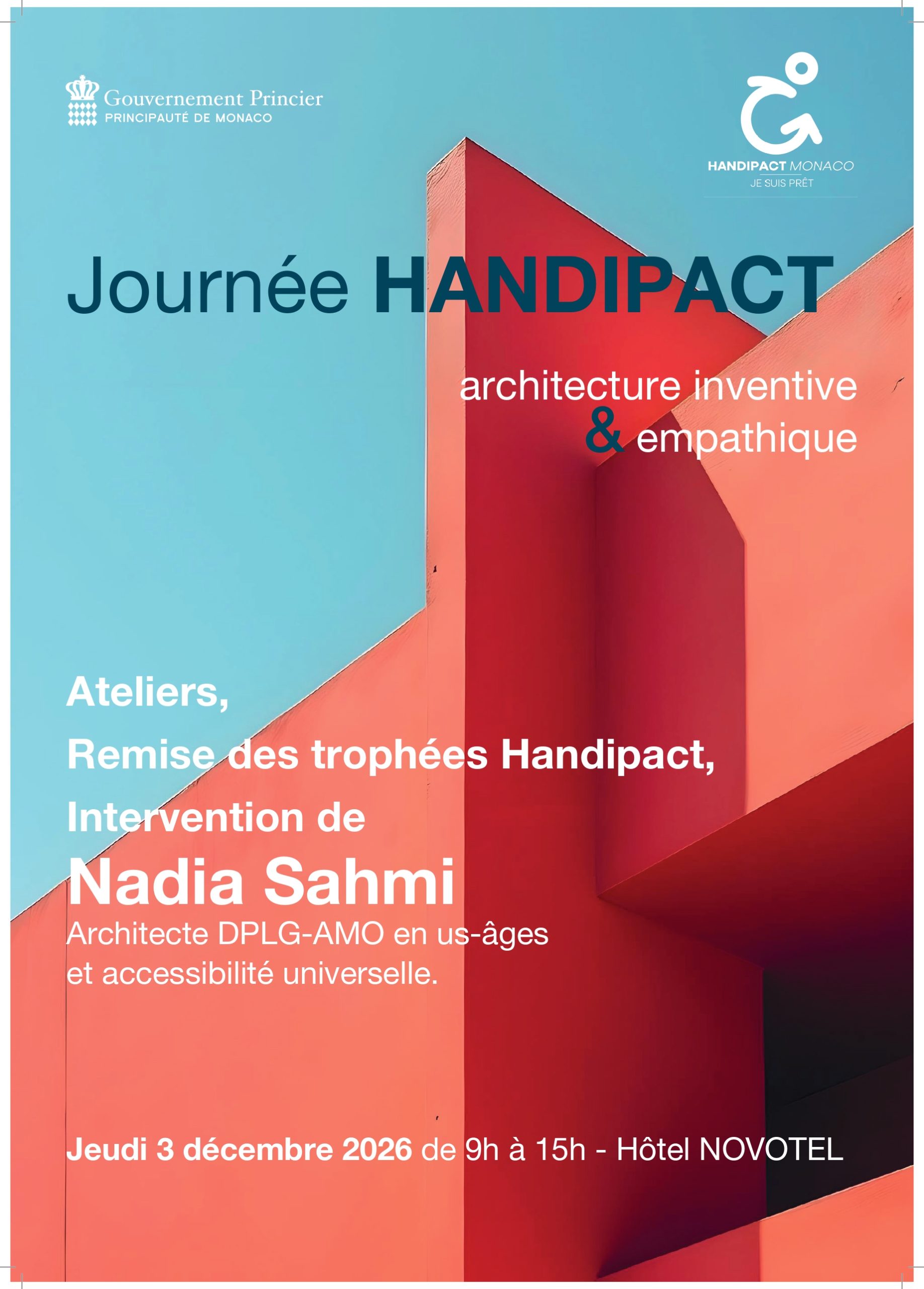
To mark the International Day of Persons with Disabilities, Monaco’s Department of Social Affairs and Health will host the third edition of Handipact Day at the Novotel on Thursday, 3 December 2026. A conference, awards ceremony and interactive workshops will make up this free event, open to everyone and dedicated to accessible, attractive architecture designed to meet the needs of all.
Share News:

Making buildings and living spaces accessible is a fundamental step towards creating a more inclusive society. In Monaco, this issue will take centre stage at the third edition of Handipact Day, organised on Thursday, 3 December 2026, by the Department of Social Affairs and Health to mark the International Day of Persons with Disabilities.
This year’s event will focus on inclusive architecture and universal accessibility, with a clear objective: to raise awareness among the general public and professionals in construction, architecture and renovation about the importance of designing spaces that meet everyone’s needs.
The initiative takes on particular significance in the context of an ageing population, which makes accessible, functional buildings increasingly important. Such spaces should be designed to accommodate people at different stages of life. Accessibility is not solely an issue for people with disabilities; it also helps improve comfort and independence for everyone, regardless of age or individual abilities.
Inclusive architecture: combining accessibility, aesthetics and quality of life
One of the key messages of Handipact Day will be that accessible architecture does not have to compromise on aesthetics. A building designed to accommodate people with different types of disabilities can also be attractive, comfortable and fully integrated into its surroundings.
The aim is to encourage a shift in both professional practices and public perceptions, urging property and construction professionals to incorporate accessibility principles from the earliest stages of project design, as well as into renovation work.
Access ramps, barrier-free routes, adapted interiors, clear signage and features that make navigation easier: every detail can help create a more welcoming environment and support the independence of those who use it.
The discussion will therefore take a comprehensive approach to universal accessibility, considering a wide range of needs and circumstances rather than focusing solely on technical requirements.
Nadia Sahmi to lead a conference on universal accessibility
The morning programme will begin at 9.30 am with a conference led by Nadia Sahmi, a DPLG-qualified architect and consultant specialising in the use of spaces and universal accessibility.
Her presentation will explore the challenges involved in designing accessible environments, highlighting architectural solutions and approaches that can promote independence and inclusion.
At 10.15 am, a discussion with the audience will provide an opportunity to explore the topics raised in greater depth. Participants will be able to share questions and reflections on the evolution of architectural practices and the integration of different accessibility needs into construction and renovation projects.
At 10.30 am, the event will continue with the presentation of the Handipact Awards, recognising commitment to inclusion and accessibility.
Interactive workshops to better understand the everyday experiences of people with disabilities
Alongside the conference and discussions, Handipact Day will place a strong emphasis on practical experiences and participation, with a series of workshops scheduled from 10.45 am to 3 pm.
These activities will give visitors the opportunity to experience some of the challenges that people with disabilities may encounter in everyday life, helping them better understand the importance of accessible environments.
Four workshops will be available:
- Ageing simulator: an experience designed to demonstrate the physical and sensory limitations that may accompany the ageing process.
- Wheelchair obstacle course: a practical exercise allowing participants to understand the difficulties associated with mobility and obstacles in public spaces and buildings.
- Introduction to sign language: a first opportunity to discover this form of communication and the importance of making interactions accessible.
- Meetings with Monegasque associations: an opportunity to exchange ideas with local organisations working to support and advocate for people with disabilities.

These workshops aim to encourage mutual understanding and highlight how inclusion also depends on recognising the everyday experiences of those concerned.
Monaco renews its commitment to inclusion
With this third edition, the Department of Social Affairs and Health is continuing its work to raise awareness of disability-related issues and encourage collective action to improve accessibility.
Handipact Day is designed for a wide audience, including residents, families, construction professionals, architects, institutional representatives, associations and anyone interested in the social challenges surrounding inclusion.
By placing architecture at the heart of the discussion, the event highlights the essential role that spatial design plays in enabling everyone to move around independently, access services and participate fully in community life.
Universal accessibility is therefore much more than a matter of technical adjustments. It is an approach that places human needs at the centre of the design of living spaces and contributes to building a society that is more responsive to the diversity of its citizens.
Handipact Day 2026 in Monaco: practical information
The third edition of Handipact Day will take place as follows:
- Date: Thursday, 3 December 2026
- Time: 9 am to 3 pm
- Venue: Novotel, Monaco
- Theme: Inclusive architecture and universal accessibility
- Organiser: Department of Social Affairs and Health
- Admission: Free and open to everyone

Programme:
- 9.30 am: Conference led by Nadia Sahmi, architect and consultant specialising in spatial use and universal accessibility
- 10.15 am: Discussion with the audience
- 10.30 am: Handipact Awards ceremony
- 10.45 am–3 pm: Practical workshops, interactive experiences and meetings with local associations
Participation in Handipact Day is free and open to everyone.
Press contact: Journalists wishing to attend are invited to confirm their presence with André Vatrican by calling +377 98 98 22 11 or emailing avatrican@gouv.mc.
Latest news

You might also be interested in:
29 September 2025

3 September 2025
Latest Articles

26 November 2026

26 November 2026

26 November 2026

25 November 2026

25 November 2026

25 November 2026
Most Read Articles

24 January 2024

28 January 2026
25 November 2026

28 January 2026
26 November 2026