




Monaco’s GDP exceeds €10.6 billion, growing by more than 50% in ten years
Monaco’s economy continues to demonstrate remarkable resilience and growth. In 2025, the Principality’s Gross Domestic Product reached €10.6 billion, recording real growth of 1.7%. Over the past decade, Monaco’s economy has expanded by more than 50%, significantly outperforming France and the eurozone.
Share News:
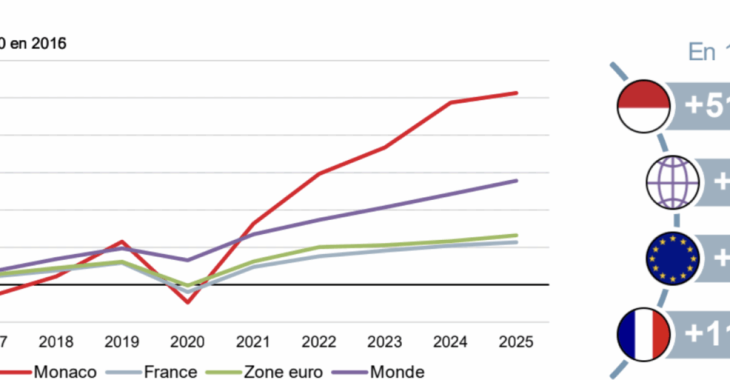
The Principality of Monaco’s economy closed 2025 on a positive note. Gross Domestic Product (GDP) reached €10.6 billion, representing a real increase of 1.7% compared with the previous year, after adjusting for inflation. This result confirms the strength of Monaco’s economic model, which has maintained positive growth despite ongoing uncertainty in the international economic environment.
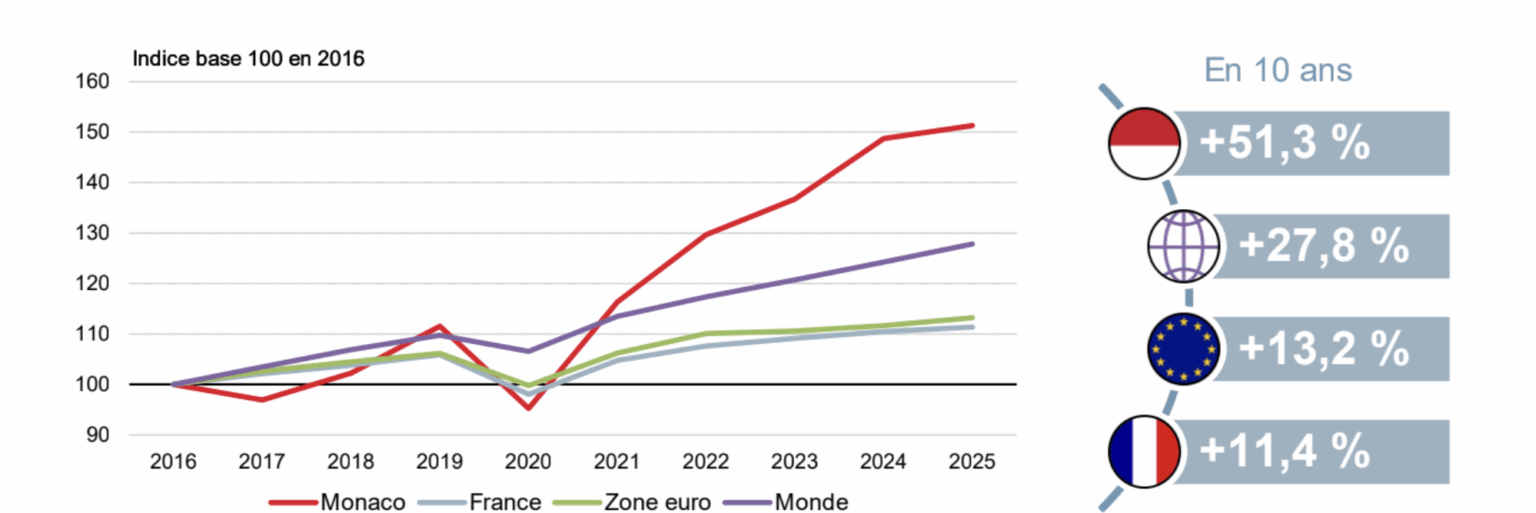
This marks the fifth consecutive year of economic growth for the Principality, a particularly significant achievement when viewed over a longer period. Over the past ten years, Monaco’s GDP has increased by more than 50%, considerably outperforming the growth recorded by major international economies.
Monaco outpaces the eurozone and France
A comparison with international economic trends highlights the Principality’s strong performance. Between 2015 and 2025, Monaco’s GDP grew by more than 50%, compared with 27.8% worldwide, 13.2% in the eurozone and 11.4% in France.
These figures underline Monaco’s ability to sustain economic growth even amid geopolitical tensions, financial uncertainty and significant changes in international markets.
The Principality’s performance reflects an economic model characterised by a strong concentration of high-value-added activities, an established financial services sector and a particularly significant property market.
Finance, professional services and real estate drive growth
Financial and insurance activities make the largest contribution to Monaco’s economy, accounting for 17.4% of total GDP. This remains a strategic sector for the Principality, which continues to distinguish itself as an international centre for financial services and wealth management.
Specialised, scientific and technical activities rank second, representing 15.4% of GDP. This sector includes a range of professional and highly skilled services that play an essential role in Monaco’s economic landscape.
Real estate is also a major contributor. With an 11.3% share of GDP, it ranks third among the Principality’s leading economic sectors. This confirms the importance of property-related activities in a territory where real estate values and associated services are central to the local economy.
Growth remains uneven across economic sectors
Despite the positive overall figures, the economic picture is not uniform. Growth has not benefited every sector to the same extent.
According to data covering the 14 main economic sectors, eight recorded an increase, two remained stable and four experienced a contraction.
This breakdown highlights the differences within Monaco’s economic structure. Even in a highly dynamic economy, individual sectors can follow very different trajectories. Overall growth is therefore the result of contrasting performances, with some industries continuing to expand while others face more challenging conditions.
GDP per capita exceeds €110,000

Another significant indicator is GDP per capita, which surpassed €110,000 in 2025, recording real growth of 1.9%.
This figure reflects the high level of economic output generated in the Principality in relation to its resident population. However, GDP per capita measures average economic production and should not be confused with the actual income received by individual residents.
Monaco confirms the strength of its economic model
The 2025 figures paint a picture of a Principality that continues to strengthen its position in the international economy. Surpassing €10.6 billion in GDP, together with sustained growth over the past decade, confirms Monaco’s ability to generate economic value and maintain positive momentum despite a challenging global environment.
Finance, professional services and real estate remain the main pillars of the Monegasque economy. The challenge in the coming years will be to consolidate these results while encouraging more balanced growth across the different sectors.
The full economic data is available on the official website of the Monaco Institute of Statistics and Economic Studies (IMSEE): https://imsee.mc/
Latest news
You might also be interested in:
5 February 2025

Latest Articles

16 November 2026

16 November 2026

16 November 2026

16 November 2026

16 November 2026

13 November 2026
Most Read Articles

24 January 2024
28 January 2026

13 November 2026

28 January 2026

13 November 2026